
Compiled by L. van Staden, 07 January 2025
Thanks to pictures sent in by one of our local residents, Ken van Tonder, we are happy to give you a bit more information regarding this species.

Note: Picture by Van Tonder, K. (January 2025)
The patchwork cuttlefish Sepia vermiculata is sometimes also known as the common cuttlefish or ink-fish in South Africa. The true ‘common cuttlefish’ is a different species (Sepia officinalis), widely distributed in the Northern hemisphere. (Two Oceans Aquarium Foundation, 2025)
It is classified as an animal in the Kingdom Animalia, Phylum Mollusca (together with all the other shellfish, Class Cephalopoda together with octopus and squid in the Order Sepiida and Family Sepiidae. (Animalia, 2020)
The patchwork cuttlefish however, is endemic to South Africa and the only South African cuttlefish that also enter lagoons and estuaries. Other members of the squid family, e.g. squid and other cuttlefish occur to depths of between 100m and 300m in the ocean. (Two Oceans Aquarium Foundation, 2025)
The genus name ‘Sepia’ refers to the fact that this group of cuttlefish have brown ink instead of the black ink of squid and others and octopus. The production of paints and pigments in the colour sepia required the drying and processing of the ink sacs, and the original use revolved around watercolour and monochromatic artwork, where we got sepia photography from. (Adobe Express, 2024)

Image from: Cabinet magazine. (2004
Like octopus, cuttlefish can change both their body colour and texture in response to their environment and their survival needs.
Watch this video by Cape Town Freediving taken in 2022, to see how they change colour.
Special cells (chromatophores) located in the outer-skin layers, contain colour pigments, which the animal can alter by neural control (merely by thinking about it!). These chromatophores typically occur in red, yellow, brown, black
Patchwork cuttlefish are the largest cuttlefish species found in southern Africa and occur from Mozambique on the east coast to the mouth of the Orange River on the west coast. They live in sheltered lagoons and estuaries and in the open ocean to depths of 200m.
Cuttlefish have tentacles including two longer ones that are hidden in ‘’pockets’’ under the eyes. They use the long tentacles during mating and for capturing their prey. These secret tentacles shoot out, grab hold of prey and bring it toward the mouth. (Real Monstrosities, 2013)
They also have another method of getting a grip on prey. They simply smother them with their arms. Watch the video uploaded in 2021 by Love Nature
The magical cuttlefish is a master of disguise. It lies in wait, as a school of fish swims above. Though there is strength in numbers, the cuttlefish carefully targets, changes colour, and strikes at the perfect moment. Its tentacles grab the fish, direct it toward its mouth, and its tongue scrapes the flesh off the bone.
They eat molluscs, fish, shrimps, crabs, worms, octopus and other cuttlefish, while sharks, dolphins, large fish, seals, seabirds and cuttlefish feed on them. (Cape Town Freediving, 2022).
They live for around 1-2 years, migrating to shallower waters in the breeding season
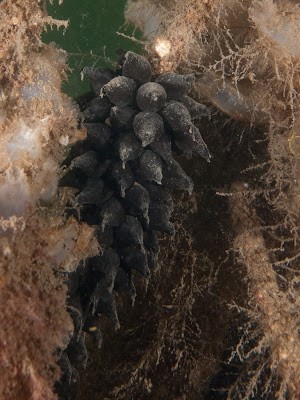
The female lays somewhere between 100 and 1,000 eggs filled with ink to provide camouflage. These eggs are all attached to sea weed, rocks or shells and are not tended by the adults. In fact, both male and female die.
The eggs meanwhile hatch after one to three months, and tiny cuttlefish just 5 cm long immediately start lunging at tiny prey. They need all the food they can get; they’ll be mature in just 18 months, ready to have children of their own and then die. (Real Monstrosities, 2013)
Inky Eggs (Image by Burgers, E. from Real Monstrosities, 2013)
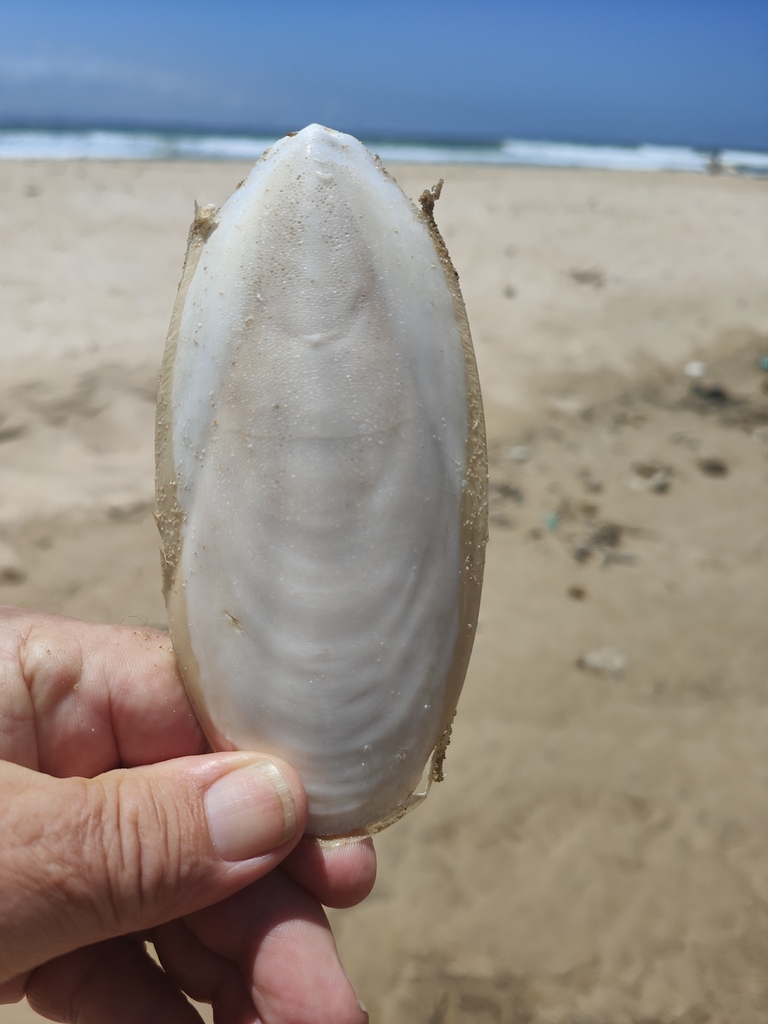
Most people are familiar with cuttlebones, which are found washed up on the beach and given to pet birds as a dietary supplement and to sharpen their beaks.
It was even once powdered and added to toothpaste…
Cuttlefish use the cuttlebone as a gas-filled internal shell made of aragonite. It’s riddled with gas-filled chambers to regulate their buoyancy.
Image of observation on 14 November 2024 from iNaturalist, 2024

References
Adobe Express. (2024). The Colour Sepia From: https://www.adobe.com/express/colors/ sepia
Animalia (2020) Cuttlefish. (2020). From: https://animalia.bio/sepia-vermiculata?taxonomy= 1758#google_vignette
Cabinet magazine. (2004). Colours / Sepia: Picturing nostalgia Article by Luc Sante, Summer 2004. https://www.cabinetmagazine.org/issues/14/sante.php
Cape Town Freediving. (July 2022). Cuttlefish changing colour. Video from: https://youtu.be/ C40_Q5SUl40
iNaturalist. (2024). Cuttlebone of Sepia vermiculata From: https://www.inaturalist.org/ taxa/151470-Sepia-vermiculata Image of observation on 14 November 2024 from: https://inaturalist-open-data.s3.amazonaws.com/photos/450312471/large.jpeg
Love Nature. (2021). Cuttlefish Waits for the Perfect Moment to Fire out Its Tentacles at Prey. Video from: https://youtu.be/NG21B2_IbS0?t=114
Real Monstrosities. (2013). Common cuttlefish. From: (http://www.realmonstrosities.com/ 2013/09/common-cuttlefish.html
Two Oceans Aquarium Foundation. (2025). Marine invertebrate: Common cuttlefish. From: https://www.aquarium.co.za/foundation/animals/common-cuttlefish